Most people who saw Zootopia 2, and helped push it past $1 billion at the global box office, would never guess that part of the film’s character performances were created in Albany, New York.
They definitely wouldn’t guess it happened inside a former Gothic Revival church.
But that’s how a lot of our work goes.
Important. Precise. Largely invisible once it’s done.
Recently, Overit Studios was featured in a Times Union column by Paul Grondahl for its role in recording original dialogue for Zootopia 2. Not the “final polish,” but something arguably more foundational: capturing performances that animators would later bring to life on screen – exactly as you hear them from the characters in the film.
The “Church of Audio”
Overit Studios operates out of the former Saint Teresa of Avila Church on New Scotland Avenue, a deconsecrated 1930s landmark transformed into a state-of-the-art recording facility in 2012.
The bones of the building are still very much alive.
The altar is now a precision recording space.
Confessionals became offices.
Original oak pews live on as desks and architectural details.
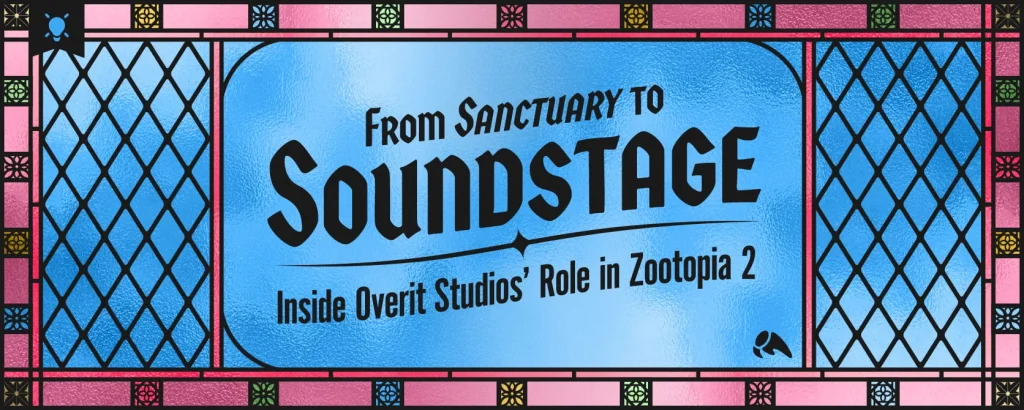
Stained glass windows frame sessions that are deeply technical and deeply human.
We joke about it being The Church of Audio, but the reverence is real. Not just for the building, but for the work.
Creating a Character Before It Exists
Over several sessions, Overit Studios recorded actor David Strathairn performing the voice of Milton Lynxley, a central character in the film.
This process is often referred to as original voice recording or “pre-lay.”
In addition to capturing audio, the team also captured video of Strathairn’s face for animators to use as a reference when creating his character’s facial expressions. These visual references gave animators critical insight into timing, mouth movement, and subtle facial expressions, helping translate a human performance into a fully animated character.
Overit Studios also supported work for another character, Captain Hoggbottom, voiced by Michelle Gomez, in a separate session led by the team.
The sessions were highly collaborative, with directors Jared Bush and Byron Howard joining remotely to guide performance in real time.
This is where technical precision meets creative instinct.
Where Engineering Meets Performance
ADR and original voice recording are often misunderstood as purely technical processes. In reality, they sit at the intersection of engineering, performance, and direction.
As Overit Studios’ Dave Parker explains:
“One of the things I enjoy most about ADR and original voice recording is the collaboration between the actor and director. The director is usually on a Zoom session while the actor is in the booth, and I’m responsible not just for capturing clean audio, but for helping ensure the performance aligns with what’s needed.
In ADR, I’m often listening more closely to timing and delivery than anyone else in the room. The director is focused on emotion and storytelling, so sometimes I step in to guide pacing or phrasing. When that happens, I lean on my background as a musician.
It’s fascinating to watch—it’s very similar to how a producer and musician work together in a recording session. Everyone has a role, but the goal is the same: get the performance exactly right.”
That collaboration is what separates “good enough” from seamless.
Why Albany?
Reputation matters. So does geography.
For actors working across the Northeast—especially those based in the Hudson Valley—Overit offers something rare: a focused, high-end recording environment without the friction of New York City.
No gridlock. No chaos.
Just the room, the performance, and the details.
That combination has led to work on projects including The Marvelous Mrs. Maisel, The Gilded Age, CODA, Curb Your Enthusiasm, Transparent, and Nightmare Alley—along with ADR work on films like Springsteen: Deliver Me From Nowhere.
Trusted by the Biggest Names in Entertainment
Overit Studios is a SAG-AFTRA-approved facility, trusted by studios like Disney, Amazon, and Netflix, as well as global brands for commercial voice-over work.
Actors including Jon Hamm, Parker Posey, David Strathairn, and Gaby Hoffmann have recorded at the studio—sometimes between projects, sometimes on the way to the next one.
What keeps that work coming back isn’t the client list. It’s consistency.
Looking Ahead: Craft in a Changing Industry
Film and television remain a core part of the studio’s work, but they’re far from the only focus.
Overit Studios also supports large-scale voice recording initiatives for emerging technologies—projects where sound quality, nuance, and human presence matter more than ever.
The tools will keep evolving.
The expectations will keep rising.
But the fundamentals don’t change.
Judgment. Restraint. Respect for the performance.
The Work You Don’t Notice
As the Times Union piece makes clear, some of the most important work in entertainment happens far from the spotlight.
Sometimes it happens in a former church in Albany.
Sometimes it happens in a quiet recording booth, with a director on Zoom, an actor finding the moment, and an engineer listening for what no one else can quite hear.
And when it’s done right—you never notice it at all.