There’s a tendency in social media marketing to chase the moment:
- The trend.
- The format.
- The algorithm.
But every once in a while, something cuts through—not because it was engineered to perform, but because people decided it mattered. That’s what happened with Artemis II.
At Overit, we spend our time thinking like marketers, but we’re also a team that pays attention to culture as it happens. And in this case, a few of us happen to be avid NASA fans. So yes, we were watching for the moment. But we also couldn’t help but notice the work behind it—how the social media team brought this mission to life in a way that felt immediate, human, and shareable in entirely new ways.
This Was Bigger Than a Content Strategy
If you look at this mission through a traditional marketing lens, it checks the boxes.
- Multi-platform presence.
- Consistent updates.
- Behind-the-scenes access.
- A clear narrative.
The NASA Artemis Program showed up everywhere—but more importantly, it showed up intentionally.
- A dedicated Instagram account (@nasaartemis) with over 5.4 million followers
- A standalone X account (@NASAArtemis) with over 1.1 million followers
- A Facebook presence amplified through NASA’s broader channels
- A YouTube livestream that let people experience the mission in real time, amassing 14.9 million subscribers and over 27 million views
- A presence on TikTok that brought content to a Gen Z audience
View this profile on Instagram
And that Instagram account? It doesn’t behave like a typical brand channel. It acts more like a media property—documenting the mission over time, not just posting around big moments. It’s something people can follow, not just scroll past.
They also did the things brands always say they want to do:
- Gave the mission its own identity
- Created a mascot (“Rise”) through global participation
- Humanized the crew through consistent, real updates
On paper, it’s a strong social strategy. But that’s not why it worked. Because plenty of brands check these boxes, but very few create something people actually care enough about to engage with, remix, and carry across platforms.
A Historic Moment. Experienced Differently
Not everything is a marketing lesson. Some things are just…big. Artemis II was one of those moments—a return to crewed lunar orbit for the first time in over 50 years. The kind of milestone that was always going to draw attention. But attention isn’t the same as connection, and that’s where this gets interesting.
A Generation That Didn’t Grow Up With This—Showed Up Anyway
One of the more telling perspectives didn’t come from a brand or a news outlet. It came from Reddit. In this thread, a Gen Z user shared that they didn’t even know what Artemis II was until it started showing up in their feeds. No childhood memory of the moon landing = no built-in nostalgia.
And yet—they were watching re-entry for hours, updating friends and talking to family members who did see the original moon landing.
That gap matters. For older generations, space exploration is a legacy. For younger audiences, it had to become relevant in real time. And it did—through social.
This Didn’t Feel Like Content, It Felt Like Culture
On platforms like TikTok, this didn’t play out like a traditional campaign.It looked like:
- Edits set to music
- Visual storytelling tying astronauts to history, identity, and progress
- Emotional throughlines—grief, hope, connection
Even small moments took on meaning:
- Accidental moments from people watching the historic takeoff
- POV moments from the public watching the landing
- Cultural references that made the crew feel human
This is where generational behavior shows up. Gen Z doesn’t just consume moments—they reinterpret them; they remix them and make them theirs. That’s what turned a historic event into something that lived on social.
@artemisii.agency
NASA Didn’t Just Control the Narrative, It Opened It Up
From a brand perspective, the NASA Artemis Program did a lot right.
- A dedicated social ecosystem across Instagram, TikTok, X, Facebook, and YouTube
- Real-time access, including livestreams and behind-the-scenes moments
- A distinct identity for the mission
- Participatory elements, like crowdsourcing the “Rise” mascot
But the bigger move? They didn’t over-produce it. They didn’t sanitize the experience into something overly polished or overly branded. They let it feel human, slightly imperfect, and sometimes even mundane. But that’s what gave people something to attach to—and something they could take and reinterpret across platforms.
Let’s Be Clear: The Moment Did the Heavy Lifting
This wasn’t a product launch. It wasn’t a campaign engineered for engagement. It was a globally significant milestone.
And that matters, because it’s easy to look at this and think, “let’s do more of this.” But for most brands, you can’t replicate a return to the moon. But you can understand why people showed up:
- It represented progress
- It created a shared, positive moment in a heavy news cycle
- It connected generations—those who remembered, and those experiencing it for the first time
Social media didn’t create the importance. It translated it—and gave people a way to participate.
And Data Shows What Consumers Want From Brands on Social Media
There’s nothing surprising about this—people have been telling us they want this kind of content. According to Sprout Social’s 2026 Social Media Content Strategy Report, consumers are telling brands what they want to see on social media.
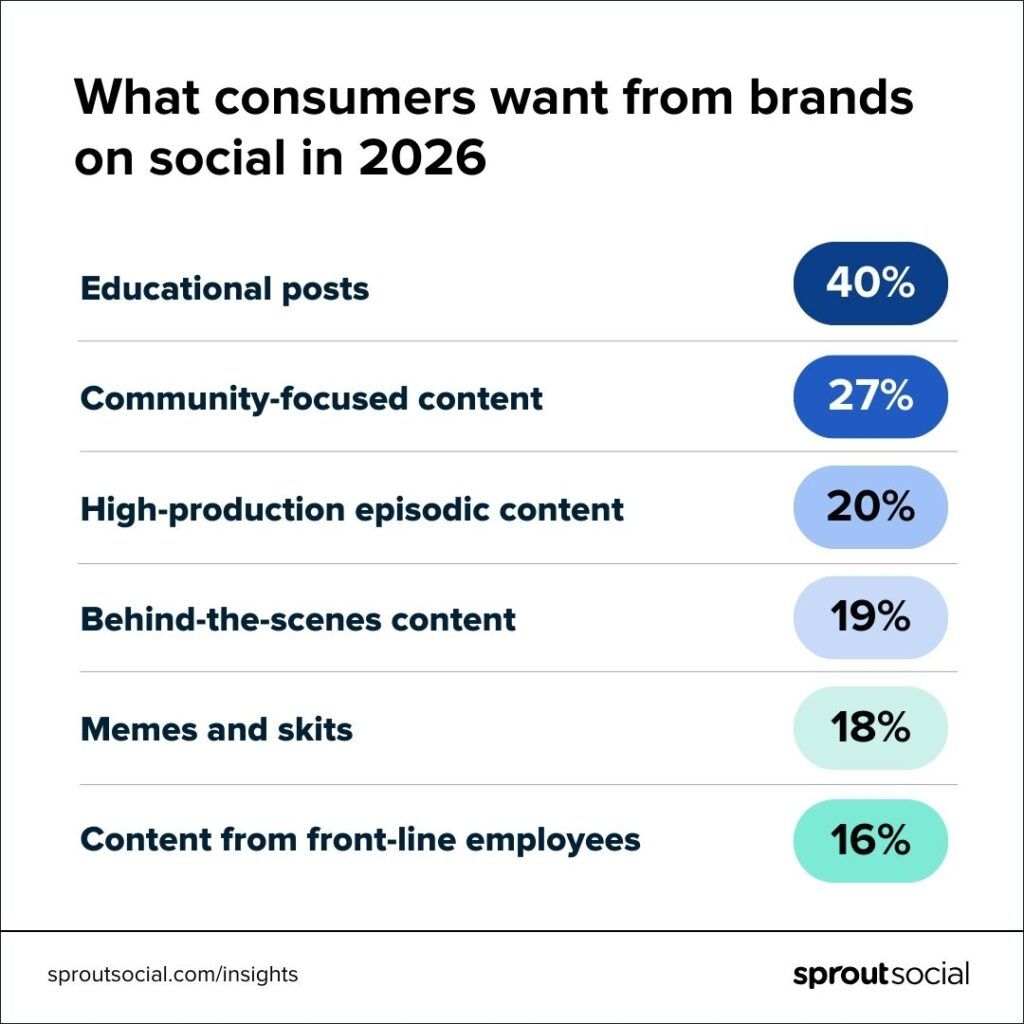
That’s not a list of formats, but also a shift in expectation. People want context, connection, and something that feels real. And that’s exactly what was delivered.
What This Means for Brands (And Where It Actually Applies)
No, your brand is not launching a lunar mission. But that doesn’t mean this doesn’t apply. Across some of Overit’s core client industries, there are moments that carry weight—they’re often treated as routine updates rather than meaningful milestones.
- Healthcare: Outcomes matter, and they’re always a key part of any story. What people connect to is how care shows up in real time—the people behind it, what patients need to know, and what it actually feels like. Show that, and the impact becomes real.
- Higher Education: The value of the degree matters—and it always will. And it’s not the only thing people connect to. For one audience, it’s a legacy. For another, it’s a first. For another, it’s a transformation. If you only market the outcome, you miss the experience. And the experience is what people follow.
- Home Services: To a contractor, it’s a project. To a homeowner, it’s stability, safety, and a fresh start. The emotional weight is there—it’s just rarely surfaced. Go beyond the before-and-after. Show the process, the decisions, and what it means for the people living in it.
- Travel & Tourism: Not every trip is just a destination. For many, it’s reconnection—with family, identity, or experience. That’s what makes it worth sharing. The destination gets attention. The experience makes it stick. Show both. Give people a reason to go—and a sense of what it actually feels like to be there. The moments, the pace, the perspective. That’s what turns interest into intent.
- Associations: Information isn’t your differentiator—community is. You’re not just delivering resources; you’re connecting people to a profession, a purpose, and a network. Start elevating people. Conversations, shared challenges, peer perspectives. That’s inherently community-driven—if you allow it to be. And it keeps people coming back.
The Takeaway Isn’t “Go Viral.” It’s This:
The social media strategy behind the Artemis II mission worked because it was well executed—with unmatched visuals and real buy-in from the people involved—and because it centered on a moment that mattered.
The strategy gave people access.
The moment gave them a reason to care.
And the takeaway isn’t to recreate the moment’s scale. It’s to understand what made it resonate:
- People were given something real to connect to.
- They were brought into it.
- And they were able to experience it in their own way.
As marketers and busy professionals, we spend a lot of time with our heads down—focused on execution, timelines, and deliverables. And when we look up—when we pay attention to what’s happening in the world and how people are experiencing it—it becomes something we can learn from.
At Overit, this is the work. Not chasing trends, but understanding how people are experiencing the world in real time—and helping brands show up in a way that actually connects.
If you’re thinking differently about how your brand shows up on social, we are too. Follow along and reach out. Let’s build something people actually care about!