I spend a lot of time these days thinking about what AI is going to change in advertising.
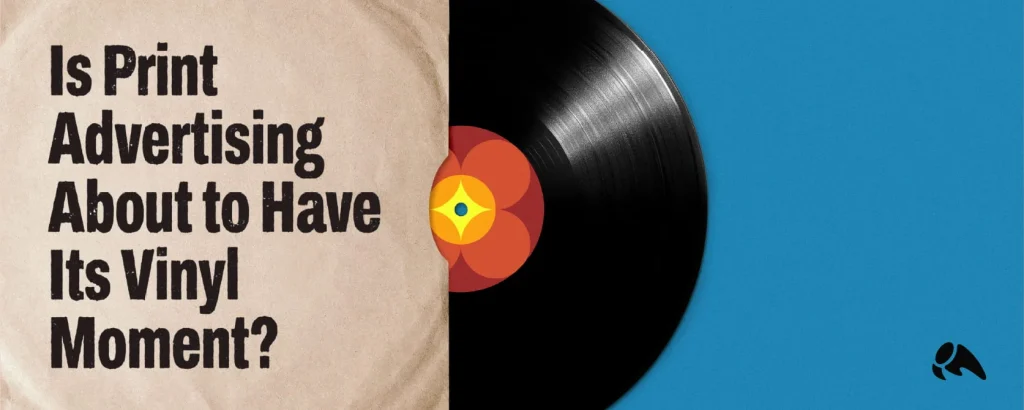
But lately, I’ve been thinking almost as much about what it might bring back. Is our increasingly digital, AI-generated world actually creating an opportunity for traditional print advertising?
It sounds counterintuitive.
We are building marketing ecosystems around AI search, automated content, personalized digital experiences, short-form video and increasingly sophisticated media targeting. We can generate an ad in seconds, serve thousands of variations and measure nearly every interaction.
Meanwhile, the brochure is sitting quietly in the corner wondering when everyone stopped inviting it to meetings.
But something interesting is happening.
Vinyl records came back. Film photography came back. Printed books never really left. Younger consumers are embracing analog cameras, physical media, handmade products and experiences that feel decidedly less digital.
And there are signs that print may be benefiting from the same cultural shift.
A 2025 Harris Poll study presented by Quad found that 78% of Gen Z and Millennial consumers said print media had influenced them to choose a brand over competitors during the previous year. The same research found 72% wished more brands would surprise them through physical mail.
Maybe print isn’t dying, maybe mediocre print died and what is coming back is something much more interesting.
1. When Everything Is Digital, Physical Becomes Different
For decades, digital advertising had an obvious advantage. It was faster, cheaper, targetable, measurable, and interactive.
And then everyone became digital.
Think about how much marketing the average person moves through every day, ads–emails, social posts, videos, banners, notifications–most of it barely registering before it disappears. We scroll past it. Skip it. Delete it. Close it. Swipe away. Ignore it. It’s everywhere, yet increasingly, very little of it actually reaches us.
We have become extraordinarily good at consuming digital information and equally good at filtering it out.
Print asks us to interact differently. We pick it up, turn it over and feel the paper in our hands. We notice its size, its texture, its weight—the physical qualities that make it feel like something rather than just another message. And instead of disappearing with the swipe of a thumb, it might stay on a desk, get pinned to a wall or simply hang around long enough to be noticed again.
That physicality suddenly feels unusual, but doesn’t mean print automatically beats digital. It means physicality itself has become a differentiator, and scarcity tends to make things more noticeable.
2. Gen Z Might Be More Analog Than We Think
We tend to make a lazy assumption about younger audiences. Digital native equals digital only. I’m not convinced that’s true.
Gen Z may have grown up with screens, but that also means they have never experienced a world without them. Physical experiences can therefore feel less old-fashioned and more novel.
USPS reports that Gen Z sees physical mail as a form of emotional connection, with most respondents saying that receiving cards, letters and packages makes them happy. Even advertising wasn’t automatically dismissed: 52% said they enjoy receiving mailed advertisements, including catalogs and coupons.
More recent research makes the trend even more interesting. Lob’s 2025 Consumer Insights study, conducted with PureSpectrum and based on a nationally representative survey of 2,000 U.S. adults, found that 85% of Gen Z and Millennials engage with direct mail.
The Harris Poll/Quad research found something similar: 84% of Gen Z and Millennials said they value brands that seamlessly blend technology with physical experiences.
That’s the important part. Young consumers aren’t necessarily rejecting digital. They’re rejecting the idea that digital should be the entire experience.
3. AI May Actually Increase the Value of Craft
AI is making content dramatically easier and faster to produce, creating an extraordinary opportunity for marketers to do more with less. But that opportunity comes with a consequence: a lot more stuff. More ads, more emails, more social posts, more imagery, more video and seemingly endless variations of all of it. As the barriers to creating content disappear, the volume competing for our attention is about to explode.
When the marginal cost of creating another piece of digital content approaches zero, sheer volume stops being particularly impressive.
As content becomes easier to create, evidence of effort may become more valuable. A beautifully art-directed catalog, a dimensional mailer, an unexpected package or an annual report that feels considered in every detail carries a different kind of weight. So does a piece that uses an unusual paper stock, embossing, die cuts or specialty printing—or a poster designed well enough that someone actually wants to hang it on their wall. These things communicate something before the audience reads a single headline:
Someone cared enough to make this.
That is increasingly meaningful in a world where audiences know perfectly well that an image, headline or entire digital campaign might have been generated in seconds.
Ironically, AI may make craft more valuable precisely because AI makes production easier.
4. The Future of Print Advertising Probably Isn’t More Flyers
This is where the conversation can go wrong. If print is experiencing a renaissance, the answer isn’t to dust off every old tactic from 2003. Nobody is asking for more generic tri-fold brochures.
The opportunity is not more print. It’s better physical experiences.
Print needs to earn its existence by creating an experience a screen simply can’t replicate. That means being intentional about materials, scale, format, typography, photography, illustration, personalization and interaction. The texture matters. The choice of paper matters. The way something is packaged, opened and ultimately revealed matters. These aren’t just production details—they’re part of the idea, shaping how someone experiences the work before they’ve absorbed a single word.
Even scent or sound can become part of the experience. A USPS student marketing challenge, for example, highlighted a winning concept incorporating texture, scent and NFC-triggered audio into a physical piece.
That starts sounding less like “collateral” and sounds more like experience design. And that’s probably where print becomes interesting again.
5. Print Doesn’t Have to Compete With Digital
For years, we’ve framed the conversation as a choice between print and digital advertising, when increasingly, that distinction misses the point. The most interesting opportunities happen when the two work together. A printed piece can launch a video through a QR code. Packaging can unlock an augmented experience. Direct mail can lead to a personalized landing page, while a catalog can inspire discovery before ecommerce completes the transaction. Even a physical invitation can build anticipation for an experience managed entirely through a digital platform. In this new relationship, print doesn’t compete with digital—it gives people a reason to enter the digital experience in the first place.
Print becomes the interruption. Digital becomes the continuation.
The Harris Poll/Quad research makes the connection between physical and digital even clearer: 78% of Gen Z and Millennials said physical mail from retailers had prompted them to visit a brand’s physical store. That matters because it challenges the way marketers have traditionally thought about channels. Consumers don’t separate their lives into print, digital, social, retail and ecommerce. Marketing departments do. People simply move from one experience to another—picking up a catalog, visiting a store, scanning a QR code, searching online or completing a purchase wherever it makes the most sense. The opportunity for brands isn’t to choose between physical and digital, but to make that movement feel natural. The strongest experiences allow one to lead effortlessly into the next.
6. Physical Objects Have a Different Lifespan
A digital ad can disappear almost as quickly as it appears, but a well-made physical object has the potential to stay. A beautiful catalog can live on a coffee table. A postcard can end up pinned to a refrigerator. Packaging gets photographed, posters get saved and publications get passed from one person to another. In those moments, the value of an impression starts to mean something different.
Much of digital media is built around rented attention–a few seconds in a feed, an impression between videos, a message competing with everything else on a screen. Physical media has the potential to become something more: owned space in someone’s environment. It can remain present long after the initial interaction, becoming part of the room, the desk or the everyday experience around it.
That’s a very different relationship between a brand and its audience, and it raises the creative bar considerably. Because earning a click is one thing. Earning a place in someone’s physical world is another. If you want someone to keep something, you have to make something worth keeping.
7. Print Can Make a Brand Feel More Real
There’s another dimension to this that becomes particularly interesting in an AI world:
Trust.
Consumers are entering an environment where it is becoming increasingly difficult to know what is generated, manipulated, automated or even real. Physical objects aren’t immune from bad information, obviously, but they do create a different psychological signal. There is permanence to putting something into print.
That sense of authenticity may be especially valuable in categories where trust and credibility carry more weight. The 2025 Harris Poll/Quad research found that 71% feel print catalogs and magazines convey a heightened sense of authenticity. In healthcare, higher education, financial services, luxury, hospitality, real estate, nonprofits and high-consideration B2B, that perception has real potential value. These are categories where decisions are rarely casual and where credibility, permanence and craftsmanship can influence how a brand is perceived. A thoughtfully designed physical piece can reinforce those qualities in a way another fleeting display ad may struggle to do. It doesn’t simply deliver a message—it can make the brand itself feel more considered, tangible and real.
8. AI Could Make Print Smarter, Too
Here’s the twist: the same technologies supposedly making print advertising obsolete may actually make it dramatically better. AI gives marketers the ability to identify audiences, understand behavior, develop personalized messaging, create imagery, generate creative variations and determine which offers may be most relevant and when to deliver them. Variable-data printing can then bring those insights into the physical world.
Instead of sending 100,000 identical postcards and hoping the message connects, brands can send fewer, smarter and far more relevant pieces. Imagery can change by audience. Messaging can reflect individual interests or needs. Offers and calls to action can vary, while QR codes or personalized URLs can lead each recipient into a different digital experience—all while remaining part of the same brand platform.
The result is a fascinating collision of old and new: the tactile presence of physical media combined with the intelligence, personalization and responsiveness we’ve come to expect from digital. Suddenly, one of advertising’s oldest channels can start behaving a lot more like one of its newest.
9. Maybe “Traditional Media” Is the Wrong Word
For years, we’ve divided marketing into two worlds: traditional media and digital media. One is often treated as a holdover from the past, while the other represents where everything is headed. But that distinction increasingly feels outdated.
A billboard doesn’t feel particularly traditional when it becomes the subject of thousands of social posts. Packaging stops being just packaging when an unboxing becomes content. A catalog can move someone directly into a personalized ecommerce experience, while a dimensional mailer equipped with NFC can launch an interactive experience right from someone’s kitchen table.
Maybe these aren’t traditional and digital channels at all. Maybe they’re simply different interfaces between a brand and a person. Some happen on screens. Others happen in our hands. And increasingly, the most interesting ideas move effortlessly between both.
So the strategic question is no longer whether print is dead. It’s what a physical experience can accomplish that another digital impression cannot.
If the answer is nothing, don’t print it. But if the answer is attention, emotion, credibility, surprise, permanence—or simply the pleasure of holding something beautifully made—then perhaps print isn’t an outdated medium at all. Maybe we’ve simply been underestimating what it can do.
The Pendulum Doesn’t Have to Swing Back.
It Can Swing Forward.
I don’t think we’re heading toward some nostalgic return to the glory days of newspaper ads, giant print runs and corporate brochures stacked six feet high in a storage closet. Good riddance to some of that.
What I do think we’re seeing is something more interesting. As marketing becomes increasingly automated, human experiences become more valuable.
As content becomes infinite, scarcity becomes interesting. As everything becomes easier to generate, craft becomes noticeable.
As our lives become increasingly screen-based, physical experiences become surprising again.
And as AI makes personalization and targeting dramatically more sophisticated, those capabilities don’t have to remain trapped inside a browser.
Maybe the future of print advertising isn’t really about going backward at all. Maybe we’re finally reaching the point where physical and digital stop competing and start making each other better.
And for creative people, that sounds like a lot more fun than designing another banner ad.
Interested in mixing up your advertising strategies? Check out Overit’s Creative Marketing and other Traditional Marketing services.
Source Links:
The Harris Poll + Quad — The Return of Touch Report:
Reimagining Consumer Engagement in 2025 View report (PDF)
Quad — Why Consumers Want More IRL and Tactile Brand Experiences View article
Lob — 2025 State of Direct Mail: Consumer Insights View report
USPS Office of Inspector General — Generation Z and the Mail View report (PDF)
USPS — Next-Gen Marketing: Direct Effect Innovation Challenge View article
Quad — 81% of Gen Z Report Wishing It Was Easier to Disconnect From Digital Devices View research summary
Quad — Inside the Return of Touch: Three Waves of Research (2026) View research